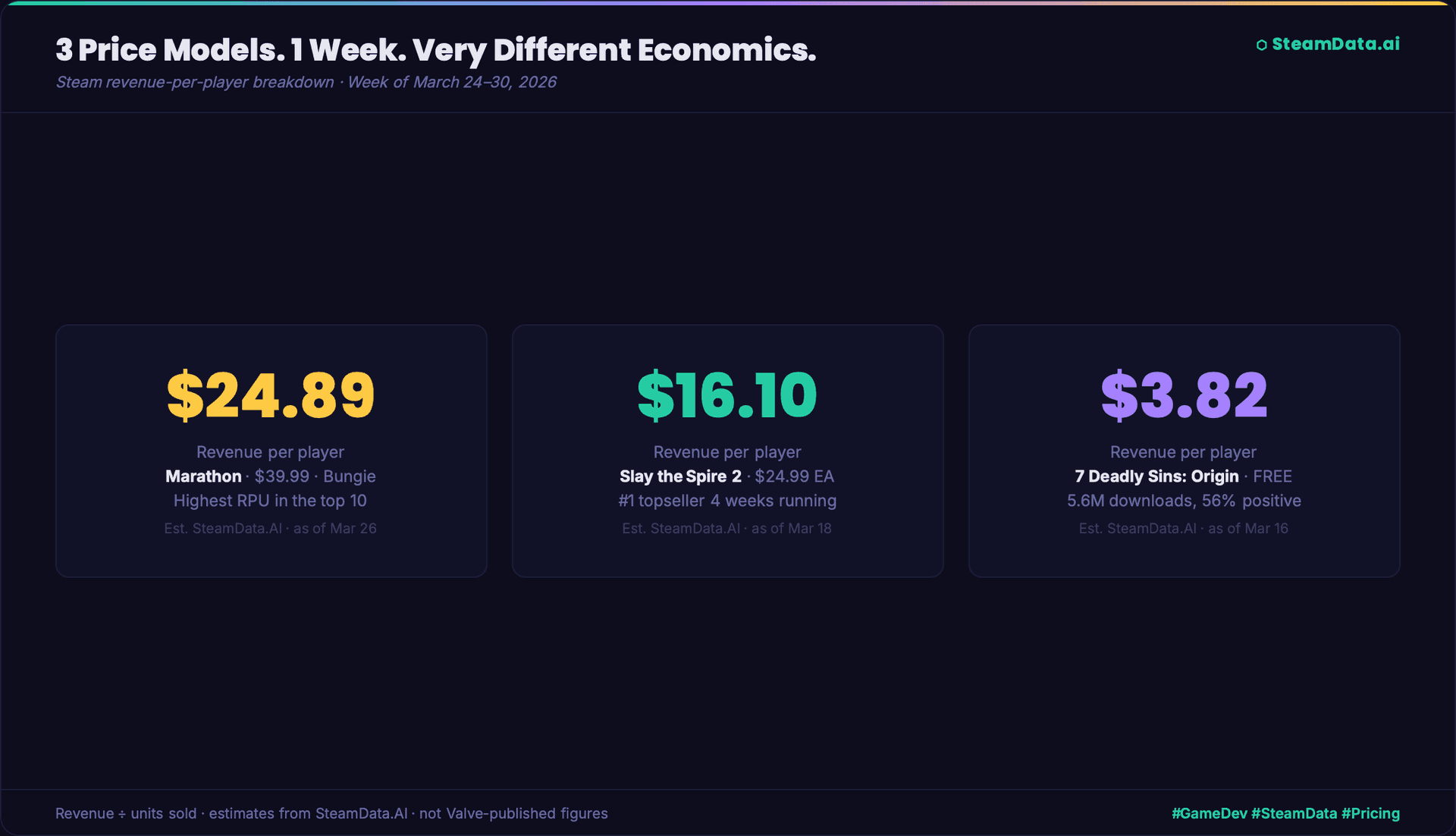
Every week, Steam's top 10 list is a natural experiment in game pricing. Different studios, different price points, different audiences — all competing for the same charts at the same moment. This week's data from March 24–30, 2026 produced one of the clearest head-to-head comparisons we've seen: free-to-play versus mid-tier paid versus sub-$10 indie, all inside a single top 10.
The metric that cuts through the noise is revenue per player (RPU) — estimated total revenue divided by estimated units sold. It's not a vanity metric. It tells you whether your players are actually paying, and how much of your ceiling you've captured.
The Mid-Tier Holds Its Ground
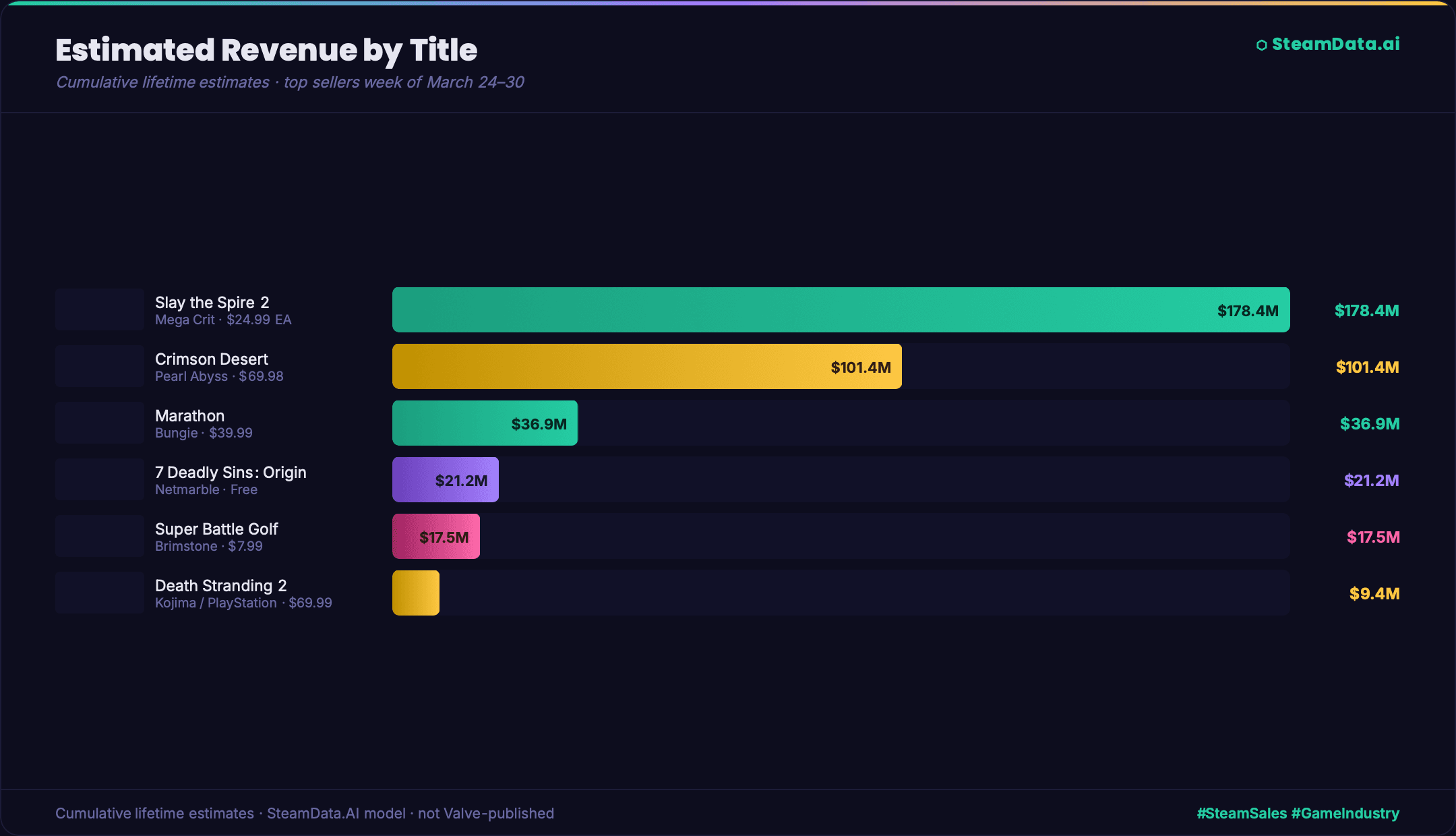
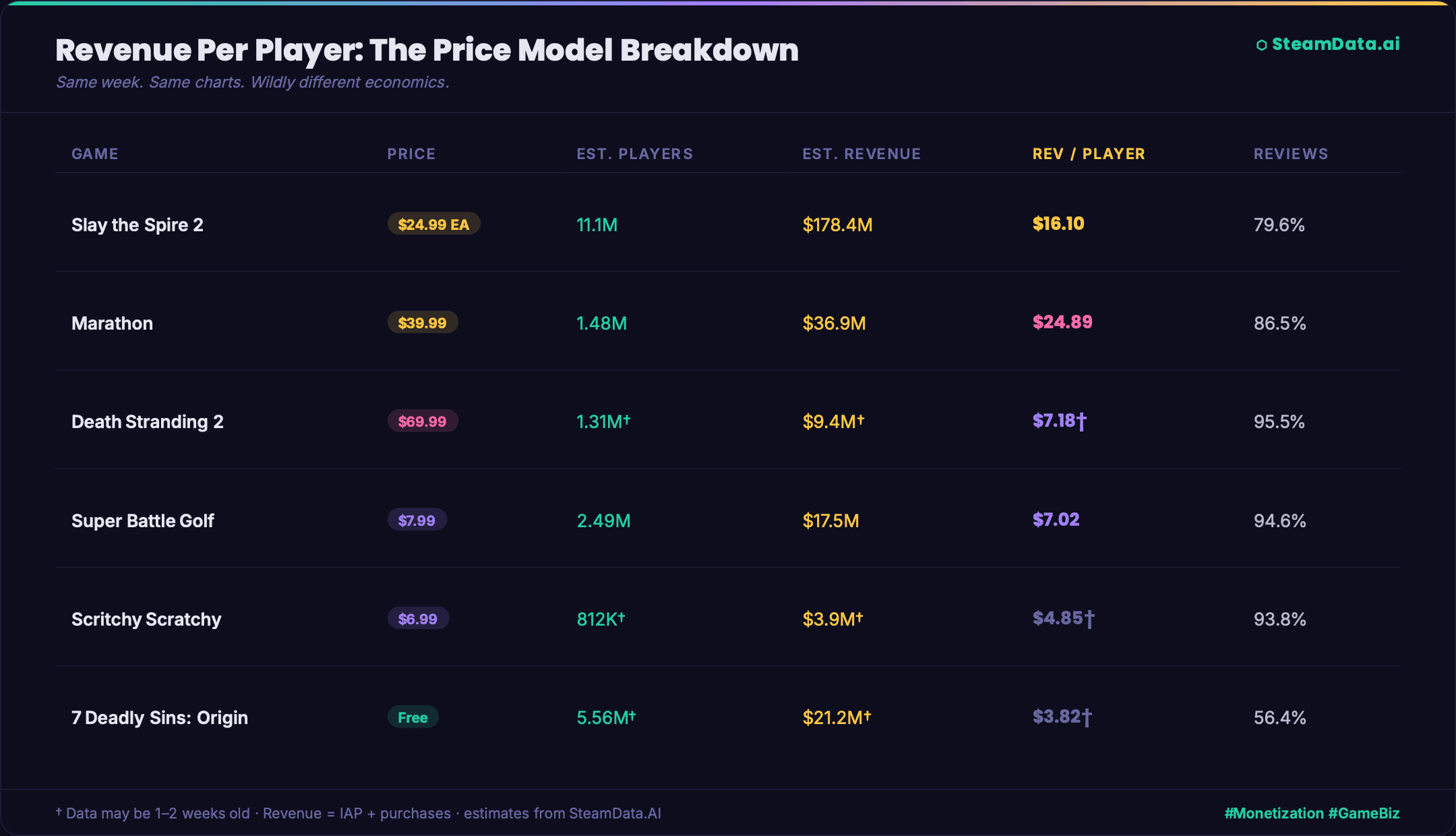
Slay the Spire 2 from Mega Crit launched into Early Access at $24.99 on March 5 and has held the #1 topselling spot for four consecutive weeks. With an estimated 11.1 million units sold and $178.4 million in cumulative revenue, its revenue per player sits at approximately $16.10 — more than double the asking price paid by regional pricing markets, reflecting a healthy mix of full-price sales, gifting, and bundle activity.
Marathon from Bungie ($39.99) tells a different story. Fewer players — 1.48 million estimated units — but the highest RPU of any game in this week's top 10 at $24.89 per player. A premium extraction shooter with strong reviews (86.5% positive on 32,000+ reviews) and a built-in Bungie fanbase produced near-full-price monetization at launch.
The F2P Download Trap
The Seven Deadly Sins: Origin from Netmarble launched free on March 16 and accumulated an estimated 5.56 million downloads — the second-highest player count among new releases this week. On paper, impressive. But estimated revenue sits at $21.2 million, yielding just $3.82 per player. Worse: its review score is 56.4% positive on over 11,000 reviews.
Low review scores in F2P games are rarely a product quality signal alone — they're often a monetization signal. Players who feel progression is gated behind purchases tend to leave negative reviews. A 56% positive rate with 5.6M downloads suggests a large proportion of installs that never converted to meaningful spend.
The Sub-$10 Overperformer
Super Battle Golf from Brimstone launched at $7.99 in February and has quietly climbed to #8 topselling with an estimated 2.49 million units and $17.5 million in revenue. Its RPU of $7.02 is nearly identical to Death Stranding 2's per-player figure ($7.18) — a $70 premium title from Kojima Productions.
The mechanism: 94.6% positive reviews on nearly 5,000 reviews drives organic chart position, which drives discovery, which drives volume. At sub-$10, you're not fighting for per-unit margin — you're fighting for volume, and a near-perfect review score is the most reliable lever to pull.
What Developers Should Take From This
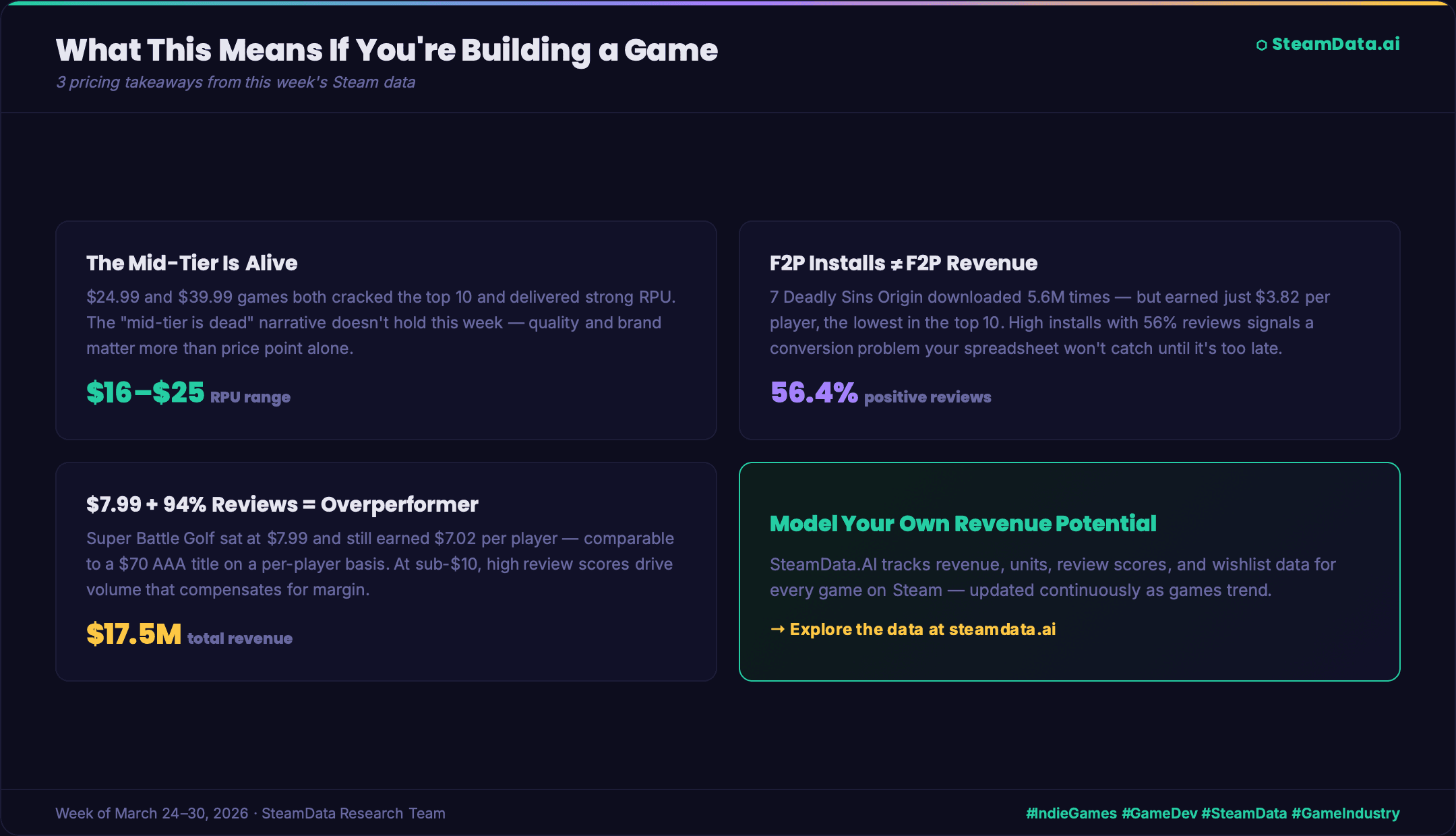
- RPU scales with review score, not just price. Death Stranding 2 has a higher list price than Marathon but a lower estimated RPU — partly because its data is from day 1 and may be stale, but also because a $70 game with strong reviews still faces regional pricing pressure.
- F2P download counts are a top-of-funnel metric, not a success metric. Monetization rate and review score tell you whether players are staying and spending.
- $7–$10 games can absolutely compete with AAA on a per-player basis, but only if reviews are exceptional. A 93–95% score at $7 outperforms an 80% score at $40 in most discovery scenarios.
- The data updates continuously. SteamData.AI tracks all of these figures in real time — useful for competitive analysis before you set your own launch price.
If you're building a game right now and trying to decide between F2P, a $10 launch, or a $30 premium price — this week's charts offer a cleaner comparative dataset than most market research. The answer isn't universal, but the data is.